
Technology in the Service of Care
The merger of National Chiao Tung University and National Yang Ming University brings together engineering, electronics, and semiconductor technologies with medicine and biology. Through innovation, it advances healthcare and safeguards human well-being. This very mission gave birth to Jumin Hospital.
We are fortunate to be rooted in NYCU, the cradle of Taiwan’s semiconductor industry, and to draw upon the resources of the Hsinchu Science Park. With the mindset of technology pioneers, we seek to build a truly transformative hospital for the future. Guided by the vision of our founding benefactors, we aim to move beyond the existing framework of Taiwan’s National Health Insurance system and create a hospital that connects with the world. Just as Taiwan’s electronics industry serves a global market, we aspire for Taiwan’s healthcare to do the same.
In the design and planning process, we set aside the constraints of traditional hospitals and instead look to the operational excellence of Taiwan’s globally leading semiconductor industry. We integrate comprehensive smart systems and automated logistics to ensure that medical equipment and pharmaceuticals are delivered accurately and on time. Sensing technologies continuously collect and analyze real-time data, improving treatment outcomes while enabling personalized, precision care tailored to each individual patient.
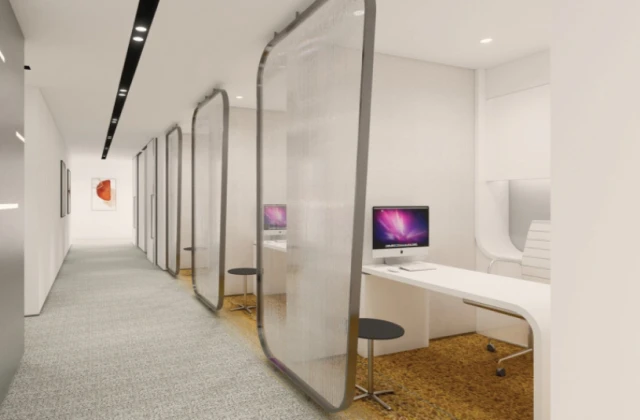
A hospital serves those at their most vulnerable, both patients and their families. While technology enhances precision and efficiency in medicine, the essence of healthcare lies in caring for people. From the very beginning of the architecture design, we set aside the traditional, specialty-based perspective and instead reimagined spatial planning and circulation through the patient journey. This approach creates private and dignified care environments, while the careful introduction of natural light and its subtle variations fosters a healing atmosphere for both body and mind. This is not only an expression of architectural aesthetics, but also grounded in medical research that natural light can help relieve pain and support recovery.
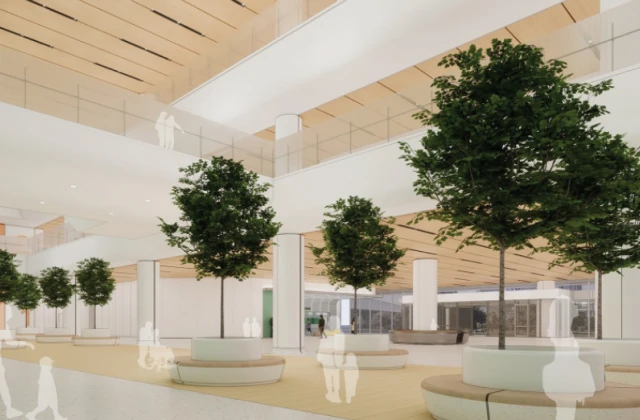
By integrating precision medicine with human-centered care, we strive to ensure that every stage of treatment takes place in an environment that is comfortable, low-stress, and as free from discomfort as possible. Conceived as a garden, the Hospital not only offers patients and families a sense of calm, but also provides medical professionals with a supportive and uplifting workplace where they can grow together.
Information and communication technology (ICT) enables healthcare services to extend beyond the limits of physical space and geography. From the earliest planning stages, the vision of cloud-based healthcare has been embedded into both the Hospital’s infrastructure and systems. Jumin Hospital is designed as a smart healthcare hub capable of delivering care without boundaries. In the future, its services will reach far beyond the NYCU campus, extending into communities and even across borders, offering seamless and continuous care wherever it is needed.
With the rise of AI, the future of medicine has become a space of renewed imagination. As an intensive care physician, each encounter with the frailty of life and the sorrow of loss deepens my hope that technological innovation can open new paths forward. At NYCU, research is advancing the creation of digital models for patients through digital twins, supporting clinical diagnosis and health risk prediction. Acting like a co-pilot at the physician’s side, these systems offer a more comprehensive view of each condition, helping reduce the risk of human error while strengthening clinical decision-making. Likewise, they remind us that medical knowledge keeps constantly evolving, calling us to approach every patient with humility.
It is my hope that every member of Jumin Hospital’s medical team will hold firmly to this belief: technology acts as a powerful foundation, but our commitment remains rooted in compassion and in seeking the greatest well-being for every patient. Through technology, we strive to elevate care, making it not only more sophisticated, but also deeply human. .
資訊與通訊技術(ICT),賦予了醫療服務突破實體空間和地理位置的侷限。從規劃之初,雲端醫療服務願景已融入醫院的軟硬體設計之中,致力於打造一座能提供無遠弗屆醫療服務的智慧醫院,未來竹銘醫院的服務不僅僅於交大的院區中,無論在社區甚至國外,都能享受到無縫的醫療服務 。
隨著AI的興起,讓大家對於醫療未來充滿想像。身為一位加護病房醫師,每次面對生命流逝的遺憾,讓我期待科技的創新能帶來轉機。陽明交大研究為病人打造數位化模型,建構數位孿生 (Digital twin),協助醫師進臨床診斷和健康風險預測,輔助臨床決策,如副駕駛般守護在側,幫助醫師以更全面的視角審視病情,降低人為失誤的風險。更提醒我們醫學知識是不斷演進讓我們以更謙遜的心面對每一位病人。
我冀盼每位竹銘醫院的醫療同仁抱持著:「科技是堅強的後盾,我們始終秉持人性關懷與謀求病人的最大福祉,用科技來提升人性化的醫療照護。 」

竹銘醫院的AI系統中還包含數位孿生(digital twin)技術,以建立每位病人的數位化模型,涵蓋其完整的病史、影像及檢查數據。
這樣的數位孿生技術不僅可以儲存病人健康數據,更可幫助醫生進行診療。透過與病人數位分身的同步,醫生能對病人情況做出更準確的診斷和治療決策,無論病人在台灣還是國外,都能提供無縫的醫療照護。
雖然目前大家常使用ChatGPT這類大語言模型,但其內容不一定完全適用於每個地方的需求,因此我們決定建立一個符合台灣需求的大語言模型,必須用我們自己的語言、自己的一個資料建立我們的模型。

我冀盼每位竹銘醫院的醫療同仁抱持著:「科技是堅強的後盾,我們始終秉持人性關懷與謀求病人的最大福祉,用科技來提升人性化的醫療照護。 」